
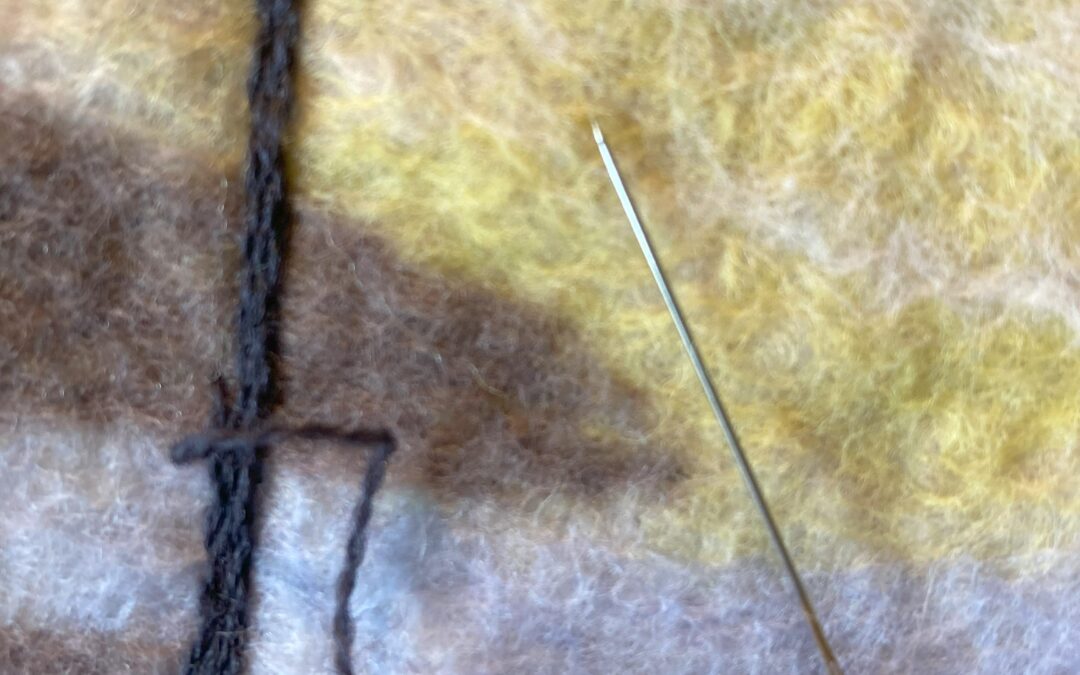
I use embroidery stitches in many of my pieces for particular details, often flowers and trees, sometimes in other details such as gates. Having said that, in order to create the marks I want, some of the stitches deviate from ‘correct’ technique or don’t really match any specific named stitch. It is always interesting to experiment with different stitches to see what types of marks they create, and consider how the marks of a landscape can be translated using different stitches (as well as different threads, but that is a topic for another blog post). At the bottom I have included details about how to find out more about these and other stitches, including sources of instructions (as they are almost certainly much clearer than any instructions I create).

Stem Stitch
The stitch that I use most often is Stem Stitch, which as its name suggests is very good for stems (such as the stems in ‘Lindisfarne Across the Sands’, pictured), as well as tree branches. I use it for just about anything that requires lines, and those lines can be curved relatively easily. I may have several parallel lines of stem stitch to build up thicker lines (for example the gate in ‘Ivy on the Gatepost’.
French Knots
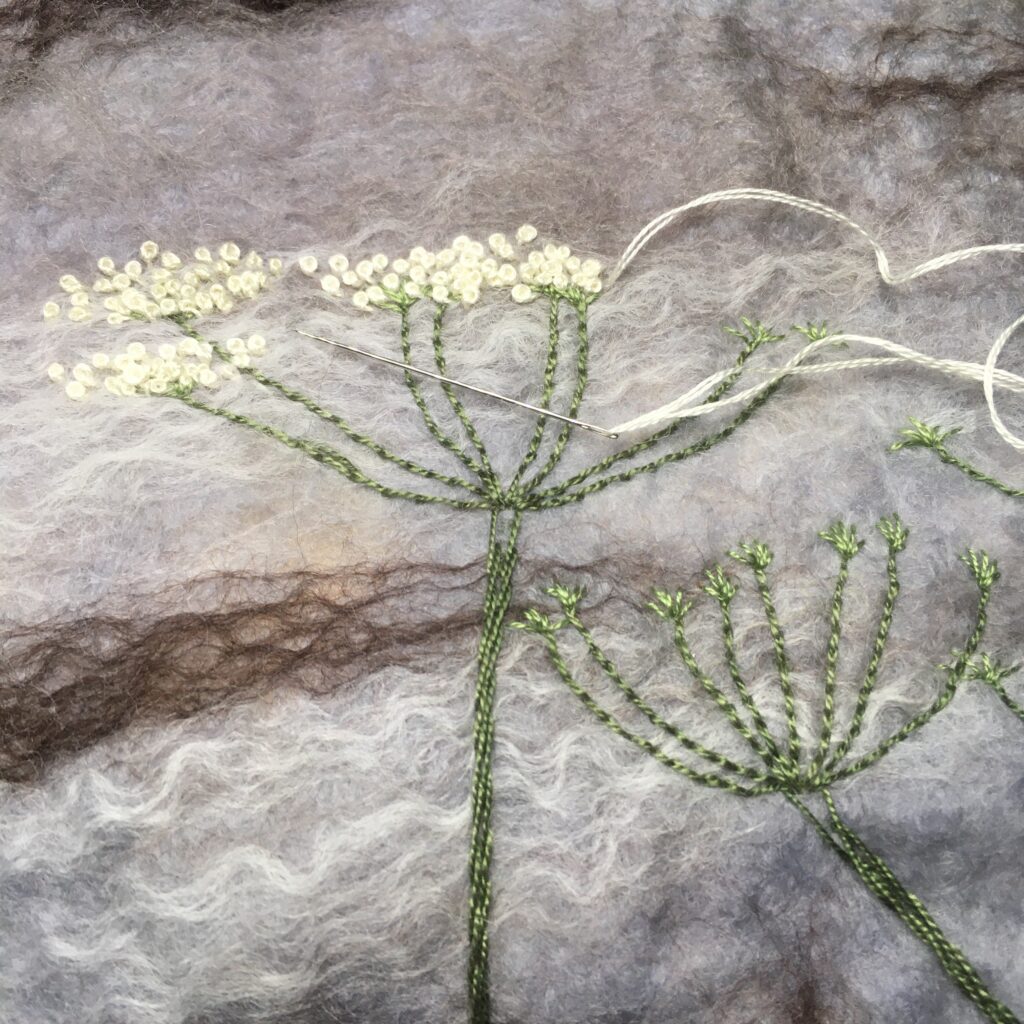
I use French Knots for most things where I want the effect of dots. Having said that they are slow and fiddly, particularly if done in large quantities, such as building up the flowers of the Common Hogweed in ‘Lindisfarne Across the Sands’, pictured in progress.
Detached Chain Stitch
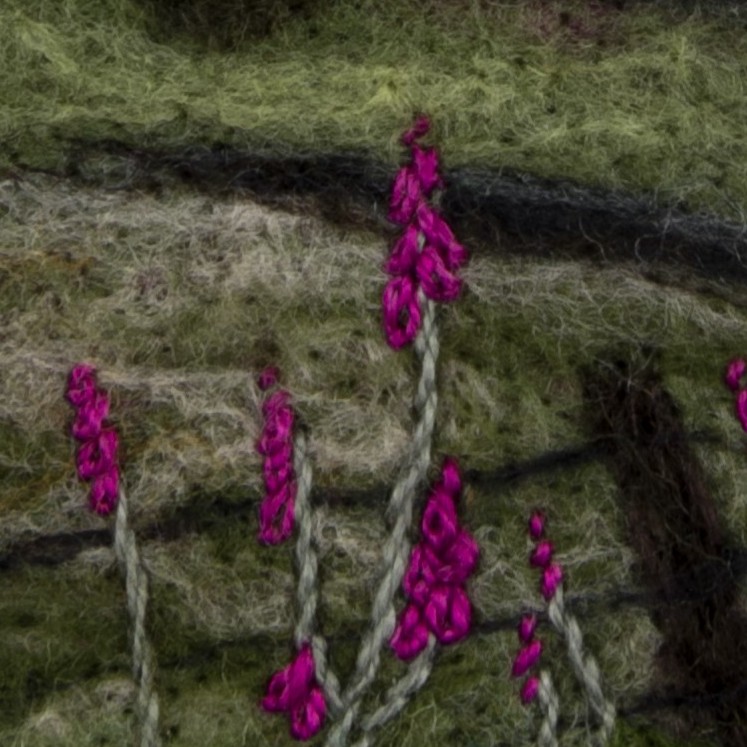
I have used detached chain stitch to suggest petals, flowers (such as the foxgloves in ‘Looking East Towards the Moors’, pictured) and parts of leaves (some of the ivy in ‘Ivy on the Gatepost’ uses detached chain stitch).
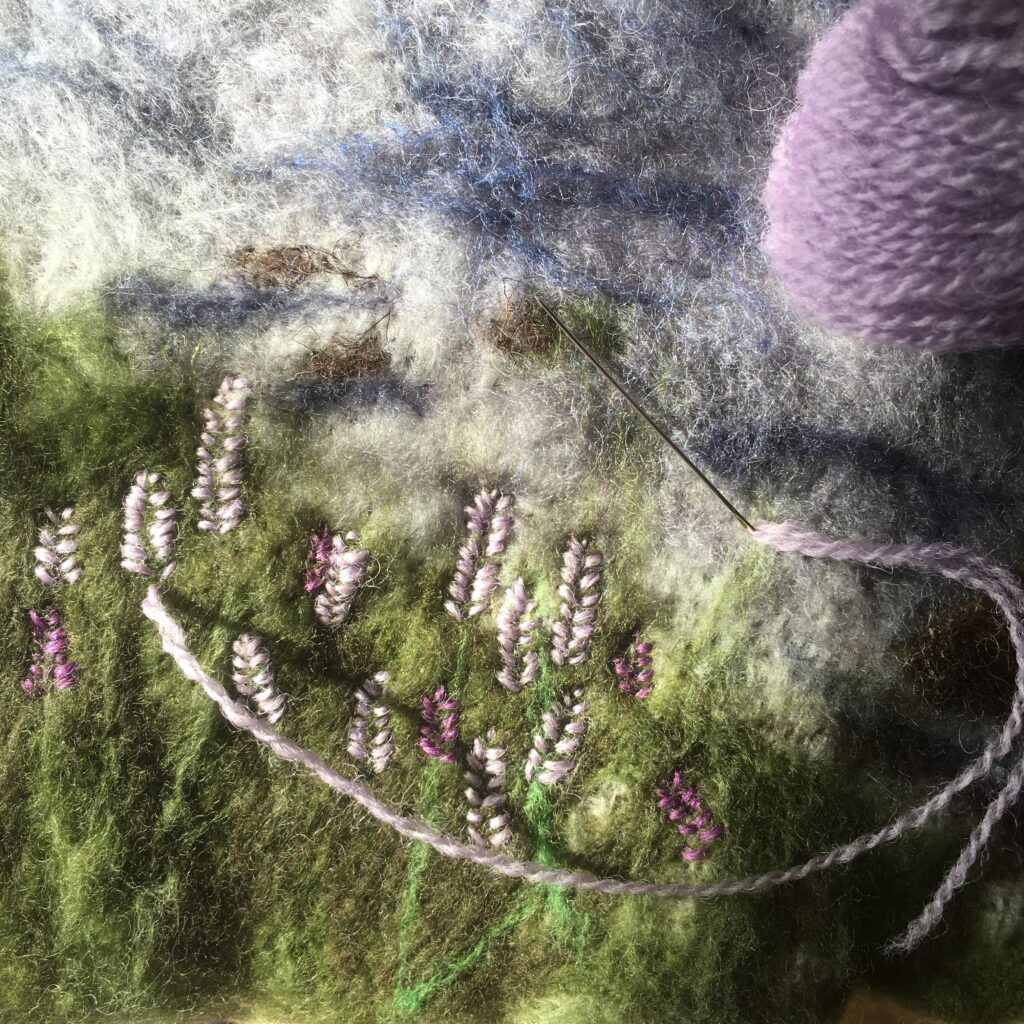
Some of the time I use individual stitches to create marks that don’t precisely match any particular stitch (for example the heather flowers in ‘Lagangarbh Hut in Glen Coe’, pictured in progress – the closest match is probably Seed Stitch, although that is often worked in a random pattern as a filling stitch).
Finding out more about stitches
The Royal School of Needlework is creating a Stitch Bank as a record of the wide variety of embroidery stitches. There are currently 475 stitches on the website, and it is an ongoing project. Photograph, illustration and video instructions are included for each stitch, as well as the history of the stitch and references. A really useful resource.
I have quite a few books with embroidery stitches for various types of embroidery, but the book that I keep coming back to is ‘The New Anchor Book of Crewel Stitches and Patterns’, compiled by Eve Harlow. I’ve found that the stitch diagrams and layout is very clear for me. The book was published in 1989 and seems to be out of print, but second hand copies are around.